
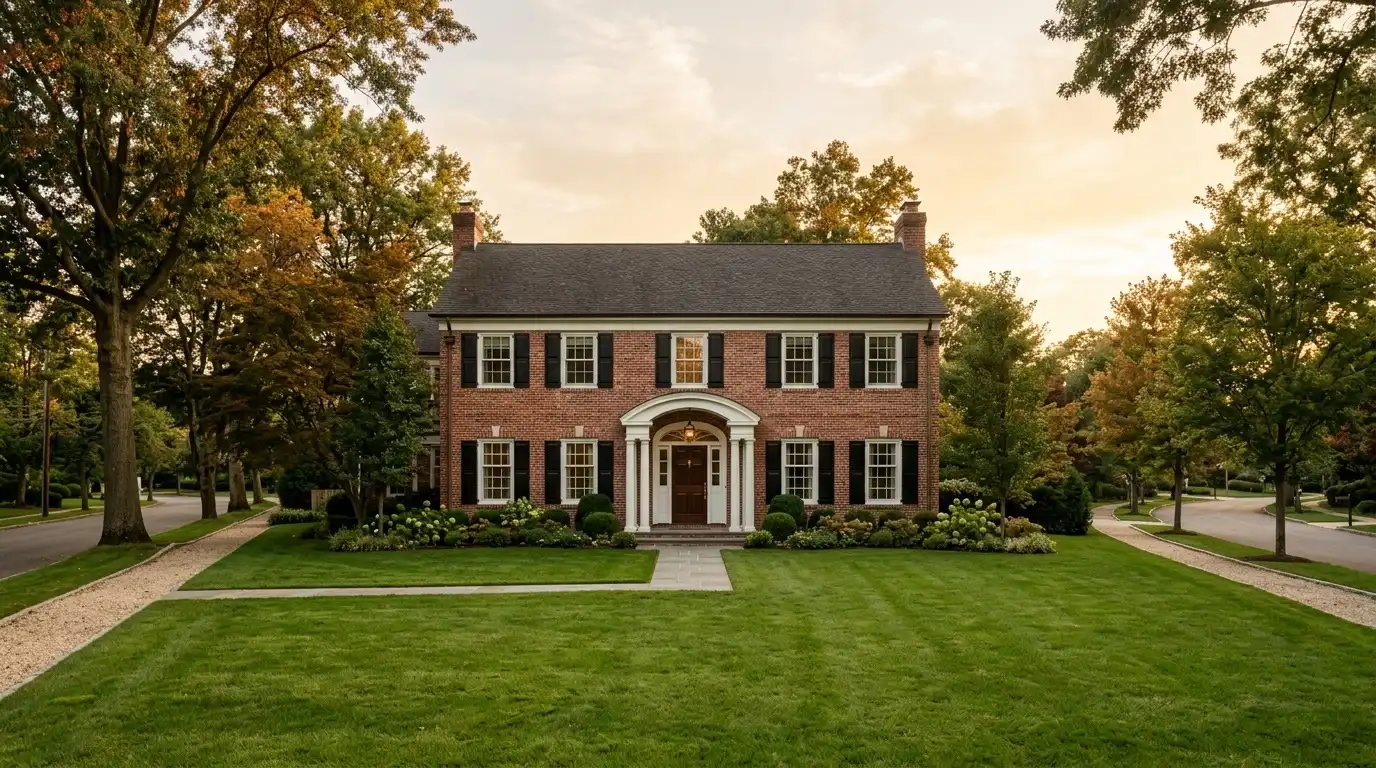
What incorporated village status means in East Hills, NY: village services and permits, the resident-only Park at East Hills, housing stock, values, village tax on top of county and town, school district assignment, and the commute.
The Short Answer
East Hills is an incorporated village of about 2.28 square miles in Nassau County, New York, governed by its own mayor and board of trustees. It runs its own building department, sanitation, and assessment roll, funds the resident-only Park at East Hills through village taxes, and spans the Roslyn, East Williston, and Jericho school districts.
Most buyers meet East Hills through a Roslyn mailing address and assume it is a neighborhood. It is not. East Hills is its own municipal government, and that single fact changes the permit you pull, the tax bills you receive, the assessment you grieve, and the recreation your household has access to. This guide covers the village as it actually functions, using the village’s own published material, New York State tax data, and U.S. Census housing estimates, with sources named so you can check every number.
The Scout Residential Team at Compass works this village constantly. We are the number one team at Compass Long Island, the number two team on Long Island overall, and number 177 nationwide on the RealTrends Large Teams by Volume list, with more than $129 million closed in 2025 and approximately $199 million pending and sold. We are RealTrends verified and an active member of The Private Client Network. We sell more homes in Roslyn than any other team, and East Hills is a large part of why.
What Does It Mean That East Hills Is an Incorporated Village?
An incorporated village in New York is a general-purpose municipal government with home rule powers. It sits inside a town, not instead of it, so an East Hills homeowner is simultaneously a village resident, a Town of North Hempstead resident (or, for a small northeastern section, a Town of Oyster Bay resident), and a Nassau County resident. Each of those layers taxes and regulates separately.
Why East Hills Incorporated in 1931
The village was incorporated on June 24, 1931, and held its first election on July 8 that year, in barns on the Mackay estate. The motive was structural rather than sentimental: residents wanted to stay out of the Roslyn Sewer District, avoid paying for infrastructure decided elsewhere, keep commercial development out, and hold decision-making locally through municipal home rule. That founding logic still describes the place. East Hills today is almost entirely residential, and the village government still makes the land-use calls.
The map was not fixed at incorporation. In 1949 East Hills annexed the territory south of what is now the Long Island Expressway, bounded by Roslyn Road on the west, Glen Cove Road on the east, and the Northern State Parkway on the south, from the Village of Old Westbury. Between the 1960 and 1970 censuses it gained roughly 16 acres from the Village of Brookville, which is the portion of East Hills that sits in the Town of Oyster Bay. Those two annexations are the reason the village crosses a town line and a school district line at all.
What the Village Actually Runs
Village Hall sits at 209 Harbor Hill Road, East Hills, NY 11576, reachable at 516-621-5600, with published village office hours of 9:30 a.m. to 4:30 p.m. Monday through Friday except holidays. As of April 2026 the mayor is Michael R. Koblenz, who has held the office since 1995, working with a four-member board of trustees, one of whom serves as deputy mayor. The village operates an Architectural Review Board, a Zoning Board of Appeals, and a Planning Board, and their meeting calendars are the real timeline on any project that needs discretionary review.
Harbor Hill Road itself is the oldest surviving man-made feature in the village. A path alongside “Harboure Hill” appears in records dating to 1661, more than 250 years before there was a village to run it.
Services the Village of East Hills provides directly
- Sanitation and recycling: household pickup three times a week, with separate recycling pickup twice a week, on the schedule published in the village calendar.
- Roads, trees, and snow: the village Department of Public Works maintains village roads and village properties and handles snow removal.
- Building department and code enforcement: permits, inspections, and property-maintenance enforcement run out of Village Hall. Applications are filed through the village’s Cloudpermit online portal.
- Justice court: a village court hears traffic tickets and code violations, reachable at 516-621-6117.
- Public safety patrol: the village staffs a public safety patrol under a village Public Safety Director. Police service is provided by the Nassau County Police Department, not by the village.
- Village assessment and taxation: the village maintains its own assessment roll, exemption applications, and grievance calendar.
- The Park at East Hills: a village-owned, resident-only recreation complex run by the village park department.
Fire protection is provided by volunteer companies rather than the village itself: Roslyn Rescue and Roslyn Highlands. Natural gas service is provided by National Grid. Electric service is provided by PSEG Long Island on behalf of the Long Island Power Authority. Water service is split by town: the Roslyn Water District serves the Town of North Hempstead portion of the village, and the Jericho Water District serves the Town of Oyster Bay portion.
Sources: Village of East Hills, Services Provided; New York State Electric Utility Service Territories Map; Roslyn Water District service profile. Retrieved July 2026.
East Hills Is Almost Entirely on Cesspools and Septic Systems
This is the piece of infrastructure diligence buyers miss most often in East Hills, and it descends directly from why the village incorporated in the first place. The overwhelming majority of East Hills is not connected to a sanitary sewer system. Most homes, businesses, and other improved properties rely on cesspools and septic systems. A regional sewer plan in the 1970s would have brought much of northwestern Nassau County into a district, with East Hills in the second phase of the project, but the plan was shelved. The small number of village properties that are sewered connect to the Nassau County sewage network through the East Hills Interceptor line.
For a buyer, that means the sanitary system is a physical asset to inspect rather than a utility to transfer. For a seller, it means the condition, age, and permit history of the cesspool or septic system belong in the pre-listing file, not in attorney review. The village building department publishes a septic permit category and separate guidance for traditional septic systems and for innovative and alternative (IA) systems, which is the practical signal that these replacements are common enough to have their own process.
The Village Assessment Roll Is Separate From the County’s
This is the detail that surprises the most owners. East Hills maintains its own village assessment roll, its own exemption applications for veterans, seniors, volunteer firefighters, and clergy, and its own grievance night with its own RP-524 filing. That process is distinct from the Nassau County Department of Assessment process that produces your county and school tax bills. An owner who grieves successfully at the county level has not automatically grieved the village. Two relationships, two calendars.
Diligence checklist before you sign in East Hills
Because the village is its own regulator and its own assessor, three items belong in every East Hills transaction file:
- Open permits and certificates. Pull the village building department file for the address. Finished basements, pool houses, generators, and rear additions are the usual sources of an open permit or a missing certificate of completion, and the village, not the town, holds that record. The village treats a building permit that has not received a certificate of occupancy or certificate of compliance within four years of issuance as suspended, which means an old permit does not quietly expire. It has to be reinstituted through its own application.
- Both tax bills. Ask for the village tax bill and the Nassau County general tax bill, not just a portal estimate. The village line is additional.
- The assigned school district for that exact address. East Hills spans three districts and the boundaries do not follow the village line. Confirm with the district, in writing, before an offer.
- The sanitary system. Because most of the village is unsewered, get the cesspool or septic system inspected and ask the village for any septic or cesspool permit history on the parcel.
We run these checks as standard practice on our East Hills listings and on the offers we write for buyers.
What Is the Park at East Hills, and Who Can Use It?
The Park at East Hills is the amenity most associated with the village, and its ownership structure is what makes it unusual. The village acquired the former Roslyn Air National Guard Station and redeveloped it into a village-owned recreation complex on more than 50 acres. The village broke ground on September 19, 2004. The pool, locker rooms, and grille opened over the July 4th weekend in 2006, and the full grand opening was held on Labor Day, September 4, 2006. The village describes the redevelopment as a $17 million project, financed through the sale of village bonds, with the carrying and operating costs paid through village taxes.
The village’s own account describes a 12,000-square-foot pool with a 100-foot water-park-style slide, Italian-tiled locker rooms, a park grille, six tennis courts, two basketball courts, a senior and community center, a renovated auditorium, a nature walking trail and a jogging trail, playgrounds, a picnic area, a workout room, sports fields, a 300-foot winter sled hill, and two dog parks separated by dog size. Roughly 15 acres of the site are preserved as open land for walking. The village also runs a fitness center, a community lounge, a tennis program, and pickleball courts.
Access is by village-issued park card, and the park is open exclusively to East Hills residents and their guests. Every household member over two years of age needs a card, and the application requires photo identification plus a copy of the deed and at least two additional documents showing the East Hills address. Each residence receives ten free guest passes per year. There is no separate club membership to buy and no initiation to negotiate, because the park is a municipal facility carried on the tax roll. Source: Village of East Hills, Park History and park card application materials.
Why the park matters to value, in plain terms
A private club membership is portable, competitive, and priced by a board. Municipal recreation is attached to the deed. In East Hills, pool, fitness, tennis, pickleball, basketball, fields, trails, and dog parks come with the address and are funded through the village tax line rather than dues. That structure is a documented, checkable difference between an East Hills home and a comparable home a few streets outside the village line, and it is a point we make explicitly in listing presentations and in buyer comparisons.
What Kind of Housing Stock and Lots Does East Hills Have?
East Hills is a postwar suburb built on top of a Gilded Age estate. By the village’s own account, at incorporation in 1931 the land area was 98 percent farm and estate holdings, with 65 homes occupying the remaining 2 percent. Today the ratio is reversed: 98 percent of the land area is occupied by homes, less than 2 percent remains undeveloped, and the village puts the current count at about 2,300 homes. The village’s residential character is not a preference. It is essentially built out.
The Subdivisions That Define the Village
Most East Hills addresses sit in a named postwar development, and those names still carry meaning on the ground:
- Strathmore, developed by Levitt & Sons in the late 1940s.
- Country Estates, built by Country Estates, Inc. over Clarence Mackay’s former Harbor Hill estate.
- Norgate, developed by Gustav A. Mezger & Co.
- Lakeville Estates, a 175-home subdivision developed by Klein & Teicholz around 1957.
- Canterbury Woods and Fairfield Park, the two developments that the Moore & Hutchins-designed East Hills School was built between in 1953. The village’s own history records that the neighborhood now known as Fairfield Park was once a polo field.
Because the village filled in over roughly two decades, the era of construction is consistent in a way that is useful when pricing. The Census Bureau’s American Community Survey five-year estimates put the median year of construction in East Hills at 1956. The practical consequence is that the market is largely a renovation market: mid-century ranches, splits, colonials, and expanded capes on established lots, with a steady flow of gut renovations, dormered second stories, and full rebuilds layered on top. Two houses of the same original model on the same street can trade very differently depending on which generation of work has been done and whether it was permitted through the village.
Lot Pattern, Topography, and the Estate Layer
The village sits on Harbor Hill, among the highest ground in Nassau County and the namesake of the Harbor Hill Moraine. Elevation and grade are real variables here: sloped lots, walk-out lower levels, and long driveways are common, and grade drives both drainage diligence and buildable-footprint questions.
The estate layer is still visible. Clarence and Katherine Mackay settled here in 1898 and commissioned Stanford White to design Harbor Hill. The mansion was demolished before Country Estates was built, but three surviving estate structures were listed on the National Register of Historic Places in 1991: the Mackay Estate Dairyman’s Cottage, the Mackay Estate Gate Lodge, and the Mackay Estate Water Tower. Townsend Cemetery, off Northern Boulevard near the northeastern corner of the village, is another surviving historic site.
Housing type is uniform, and the data says so plainly. In the 2020 to 2024 American Community Survey five-year estimates, all 2,225 estimated housing units in East Hills village are recorded as one-unit detached homes. Of the 2,169 estimated occupied units, all 2,169 are owner-occupied and zero are renter-occupied. The same estimates put the median number of rooms at 10, with about 39 percent of units at five or more bedrooms, 34 percent at four bedrooms, and 24 percent at three bedrooms. There is effectively no condominium, townhouse, or rental inventory inside the village line, which is why buyers who want attached or maintenance-free product on the North Shore end up looking outside East Hills. Source: U.S. Census Bureau, American Community Survey 2020 to 2024 five-year estimates, tables B25024, B25003, B25018 and B25041, East Hills village, New York. Retrieved July 2026.
What Do Homes Cost in East Hills?
Below is the value distribution for owner-occupied homes in East Hills village from the most recent American Community Survey five-year estimates. These are owner-reported values gathered across a five-year window, not closed sale prices, so treat the table as a picture of the housing stock rather than as today’s market. It is a sourced, dated, and checkable baseline, and every figure below can be verified against the table numbers named in the source line.
| Self-reported value band | Owner-occupied homes | Share of owner-occupied homes |
|---|---|---|
| Under $750,000 | 116 | 5.3% |
| $750,000 to $999,999 | 302 | 13.9% |
| $1,000,000 to $1,499,999 | 699 | 32.2% |
| $1,500,000 to $1,999,999 | 578 | 26.6% |
| $2,000,000 or more | 474 | 21.9% |
| Total | 2,169 | 100% |
Median value of an owner-occupied home: $1,461,500, margin of error plus or minus $167,867. Source: U.S. Census Bureau, American Community Survey 2020 to 2024 five-year estimates, tables B25075 and B25077, East Hills village, New York. Retrieved July 2026.
Actual transaction bands run differently from self-reported values, and they move. As a working frame for 2026, the entry point in East Hills tends to be an original or lightly updated mid-century house on a standard lot, the center of the market is a renovated or expanded house, and the top of the market is new construction and large rebuilds, with Country Estates addresses and elevated grade positions carrying a premium. We price off closed comparables on the specific street and the specific level of renovation, not off a village-wide average, because a village-wide average is exactly what causes sellers to leave money on the table.
What is an East Hills house worth today?Village tax, subdivision, and whether a house is original or rebuilt move the number more than any village-wide average will show.
Get a professional valuationHow Do Property Taxes Work in East Hills?
An East Hills homeowner receives more tax lines than a homeowner in an unincorporated hamlet nearby. The stack is: Nassau County, the town (North Hempstead for most of the village, Oyster Bay for the small northeastern section), the assigned school district, applicable special districts, and the Village of East Hills. The village line is the addition, and it is what funds village sanitation, public works, code enforcement, the justice court, the public safety patrol, and the debt service and operations of the Park at East Hills.
The school district line is by far the largest single component, and because East Hills spans three districts across two towns, two otherwise similar houses in the same village can carry different school tax rates. The table below shows published full-value rates for the two towns East Hills sits in. The three school district rows are alternatives, not additions: any given parcel is in exactly one district, and a parcel’s town determines which town row applies to it. These are levy-driven rates published by New York State. They are a statement about tax bills, not about the districts themselves.
| Taxing entity | Full-value tax rate per $1,000 of market value | Applies to |
|---|---|---|
| Nassau County | $3.04 | All East Hills parcels, in either town |
| Town of North Hempstead | $0.80 | Parcels in the Town of North Hempstead, which is most of the village |
| Town of Oyster Bay | $2.87 | Parcels in the small northeastern Town of Oyster Bay section |
| Roslyn Union Free School District | $13.23 | Parcels assigned to Roslyn, in the Town of North Hempstead |
| East Williston Union Free School District | $18.09 | Parcels assigned to East Williston, in the Town of North Hempstead |
| Jericho Union Free School District | $14.17 | Parcels assigned to Jericho, in the Town of Oyster Bay |
Source: New York State Department of Taxation and Finance, Real Property Tax Rates Levy Data By Municipality, published on data.ny.gov. Roll year 2024, fiscal year ending 2025, Nassau County, Town of North Hempstead and Town of Oyster Bay rows. Rates are stated on a full-value basis. Note that the same school district can publish a different full-value rate in each town because the two towns are equalized separately, so a Jericho-district rate quoted from a North Hempstead source does not apply to an East Hills parcel.
Two practical notes. First, the village budget year runs from June 1 to May 31, so village tax timing does not line up with the county or school calendars. Second, exemptions are filed separately: the village accepts its own veterans, senior citizen, volunteer firefighter, and clergy exemption applications, and filing at the county does not file you at the village. Both sets of forms are published on the village website.
Which School District Is an East Hills Address In?
This section is factual assignment only. It describes where boundaries fall, not how any district compares to any other.
East Hills is served by three public school districts, and which one applies depends entirely on the address:
- Roslyn Union Free School District covers most of the village. The district also serves the villages of Roslyn and Roslyn Estates in full and portions of Flower Hill, North Hills, and Roslyn Harbor, plus parts of the hamlets of Greenvale and Roslyn Heights. Its campuses, with the addresses each school publishes itself, are Heights School at 240 Willow Street, Roslyn Heights, which carries the district’s earliest grades and publishes kindergarten and first-grade curriculum guides; East Hills School at 400 Round Hill Road, Roslyn Heights, which publishes curriculum guides for grades 2 through 5; Harbor Hill School at 3 Glen Cove Road, Greenvale, which publishes curriculum guides for grades 1 through 5; then Roslyn Middle School and Roslyn High School at 300 Harbor Hill Road, Roslyn. The district also runs a Universal Pre-Kindergarten program. Elementary campus is assigned by attendance zone, not by grade alone, so confirm the campus for a specific address with the district.
- East Williston Union Free School District serves some of the southeastern portions of the village, along with the Village of East Williston in full and portions of Roslyn Heights, Mineola, and Old Westbury. Its schools are North Side School, Willets Road School, and The Wheatley School.
- Jericho Union Free School District serves the small portion of East Hills that lies within the Town of Oyster Bay, the roughly 16 acres annexed from Brookville between 1960 and 1970.
Because these lines were drawn independently of the village boundary, district assignment is an address-level question and should be verified directly with the Roslyn, East Williston, or Jericho district before an offer is made. We confirm it in writing as part of diligence on every East Hills transaction we handle.
Library service follows a similar split and catches people off guard. Most of East Hills falls within Roslyn’s library district, served by The Bryant Library, the public library located in the Village of Roslyn. Some southeastern portions of the village are not within the boundaries of any library district or service area at all, and the Town of Oyster Bay portion falls within the Jericho Library District. New York State requires libraries in the Nassau Library System to issue access cards to residents of unserved areas, which is the mechanism that covers the gap. As with school assignment, this is an address-level question. Confirm it for a specific parcel before you rely on it.
How Is the Commute From East Hills?
By Rail
There is no Long Island Rail Road station inside the village limits, although the Oyster Bay Branch forms part of the Roslyn to East Hills border. The nearest station is Roslyn, at Station Plaza on Lincoln and Railroad Avenues in Roslyn Heights, west of Roslyn Road and south of Warner Avenue. It is an accessible station with parking, in LIRR fare Zone 7, 22.2 miles from Long Island City, with Albertson and Greenvale as the adjacent stops on the same branch. NICE bus routes n23 and n27 serve the station.
The Oyster Bay Branch is electrified only between Mineola and East Williston, with diesel service beyond, and most branch trains originate or terminate at Jamaica rather than running through. In practice that means most East Hills commuters change trains, typically at Jamaica or Mineola, to reach Penn Station or Grand Central Madison, with a limited number of rush-hour trips running further west.
By Road and Bus
Three limited-access or arterial routes touch the village, which is part of why it developed when it did. The Long Island Expressway, Interstate 495, runs through the southern portion of the village between Glen Cove Road, County Road 1, at Exit 39 on the eastern border with Old Westbury and Roslyn Road, County Road 7, on the western border with Roslyn Heights, with Exit 38 inside East Hills. The Northern State Parkway forms the village’s southern boundary with Roslyn Heights, and Northern Boulevard, New York State Route 25A, runs along the entire northern boundary with Greenvale and Old Brookville. Harbor Hill Road, Round Hill Road, Red Ground Road, Chestnut Drive, Locust Lane, Old Powerhouse Road, Old Westbury Road, Glen Cove Road, and Roslyn Road carry most local traffic.
Nassau Inter-County Express operates the n20H along Northern Boulevard on the village’s northern edge and the n27 through the heart of the village on Harbor Hill Road and along Glen Cove Road.
Buying or selling in East HillsCurrent availability across East Hills and Roslyn, plus what has recently closed.
See Roslyn and East HillsWhat Should East Hills Sellers Know Before Listing?
Our business is more than 70 percent seller-weighted, and East Hills sellers face a specific set of variables that a generic listing process misses.
First, the buyer pool is segmented by district before it is segmented by price. Because three districts touch this village, the pool for a given house is narrower and more specific than a village-wide comparable set implies. Pricing a southeastern East Hills house against Roslyn-district comparables, or the reverse, produces the wrong number in either direction.
Second, the permit file is a marketing asset or a closing problem, and you choose which. In a village that runs its own building department, an unpermitted finished basement or an unclosed pool permit surfaces during attorney review at the worst possible time. Resolving it before listing preserves both price and timeline.
Third, the renovation generation is the pricing variable that matters most. In a stock with a median build year of 1956, the market is not paying for square footage in the abstract. It is paying for which systems, which roof, which kitchen, which bathrooms, and which additions have been done, permitted, and finished. Two comparable-looking houses on the same street routinely support very different numbers for exactly this reason.
Fourth, the village services story deserves to be stated plainly. Municipal recreation attached to the deed, resident-only park access with no club membership to buy, three-times-weekly sanitation with twice-weekly recycling, and a village department of public works that maintains village roads are concrete, verifiable differences from homes just outside the village line. They belong in the marketing, stated as facts with the village as the source.
Fifth, the sanitary system is a pre-listing item, not a closing surprise. In an unsewered village, an aging cesspool or an undocumented septic replacement is one of the few issues that can move a deal after inspection. Handling it before the first showing is cheaper than renegotiating it after the second.
Frequently Asked Questions About East Hills, NY
Is East Hills, NY an incorporated village?
Yes. East Hills is an incorporated village in Nassau County, New York, incorporated on June 24, 1931. It covers about 2.28 square miles, most of it inside the Town of North Hempstead, with a small northeastern section inside the Town of Oyster Bay. The village is governed by a mayor and a board of trustees and maintains its own building department, code enforcement office, department of public works, justice court, assessment roll and village tax. Residents pay village taxes in addition to Nassau County, town and school district taxes.
What school district is East Hills in?
East Hills is served by three public school districts, and assignment depends on the address. Most of the village falls within the Roslyn Union Free School District, which operates East Hills School at 400 Round Hill Road. Some southeastern portions of the village are served by the East Williston Union Free School District, and the small section inside the Town of Oyster Bay is served by the Jericho Union Free School District. Because these boundaries do not follow the village line, verify the assigned district and campus for a specific address with the district before making an offer.
What is the Park at East Hills and who can use it?
The Park at East Hills is a village-owned recreation complex on more than 50 acres, built on the site of the former Roslyn Air National Guard Station and opened on Labor Day 2006. It is open exclusively to East Hills residents and their guests, and entry requires a village-issued park card. Facilities include a pool and grille, a fitness center, tennis, pickleball and basketball courts, ball fields, playgrounds, two dog parks, a community lounge and roughly 15 acres kept as nature and walking trails. The village funds the park through village taxes rather than club dues.
How much do homes cost in East Hills, NY?
The U.S. Census Bureau American Community Survey 2020 to 2024 five-year estimates put the median value of an owner-occupied home in East Hills village at 1,461,500 dollars, with a margin of error of about 167,867 dollars. Within that same estimate, roughly 32 percent of owner-occupied homes fall between 1,000,000 and 1,499,999 dollars, about 27 percent between 1,500,000 and 1,999,999 dollars, and about 22 percent at 2,000,000 dollars or more. Those are owner-reported values across a five-year window, not current sale prices, so ask for recent closed comparables on your specific street before pricing.
Do East Hills homeowners pay a village tax on top of county and town taxes?
Yes. A home inside the Incorporated Village of East Hills carries a village tax bill in addition to Nassau County, Town of North Hempstead and school district taxes. The village also maintains its own assessment roll and its own grievance process, separate from the Nassau County Department of Assessment, with its own filing dates and RP-524 form. That means an East Hills owner has two assessment relationships to track rather than one. Ask for the actual village tax bill and the county general tax bill for any address you are considering.
Do you need a village permit to renovate a home in East Hills?
In most cases yes. The Village of East Hills runs its own building department and code enforcement office, and permit review happens at Village Hall at 209 Harbor Hill Road rather than at the town or the county. The village moved to the Cloudpermit online portal and stopped accepting paper building department applications after December 31, 2024, so new applications are filed online. Published village office hours are 9:30 a.m. to 4:30 p.m. Monday through Friday, except holidays. Projects may also require review by the Architectural Review Board, the Zoning Board of Appeals or the Planning Board, which adds calendar time.
Is East Hills, NY on public sewers?
No, not for the most part. The overwhelming majority of East Hills is not connected to a sanitary sewer system, and most homes and other improved properties rely on cesspools and septic systems. A 1970s regional plan that would have brought much of northwestern Nassau County into a sewer district, with East Hills in its second phase, was shelved. The few sewered properties in the village connect to the Nassau County sewage network through the East Hills Interceptor line. Buyers should have the cesspool or septic system inspected and should ask the village building department for any septic permit history on the parcel.
How do you commute to Manhattan from East Hills?
There is no Long Island Rail Road station inside the village. The nearest is Roslyn station on the Oyster Bay Branch, at Station Plaza on Lincoln and Railroad Avenues in Roslyn Heights, with Albertson and Greenvale the adjacent stops on the same branch. The branch is electrified only between Mineola and East Williston, so most trips into Penn Station or Grand Central Madison involve a transfer. By car, the Long Island Expressway runs through the southern part of the village, the Northern State Parkway forms its southern boundary, and Northern Boulevard runs along the north.
Which real estate team sells the most homes in East Hills and Roslyn?
The Scout Residential Team at Compass sells more homes in Roslyn than any other team. The team is the number one team at Compass Long Island, the number two team on Long Island overall, and ranked number 177 nationwide on the RealTrends Large Teams by Volume list. It closed more than 129 million dollars in volume in 2025, with approximately 199 million dollars pending and sold, and it is RealTrends verified and an active member of The Private Client Network. Liza Bendett and Melanie Cogan lead the team from its office at 69 Roslyn Road in Roslyn.
Buying or Selling in East Hills?
We know this village street by street, district line by district line, and permit file by permit file. Let’s talk about your move. Are you home yet?
Contact The Scout Residential TeamKeep Reading About the Roslyn Area and the North Shore
- Roslyn, NY Real Estate Guide: Homes, Villages, and Market
- Understanding the North Shore: Towns, Villages, and Hamlets Explained
- Flower Hill: One Village, Three School Districts Explained
- Who Sells the Most Homes in Roslyn and East Hills?
- What Is My Home Worth on the North Shore of Long Island?
- Moving from NYC to Long Island: Where Should You Live on the North Shore?
- The Scout Residential Team: The #1 Team at Compass Long Island
- Liza Bendett, Associate Real Estate Broker: Bio and Track Record
- Melanie Cogan: Bio and Track Record